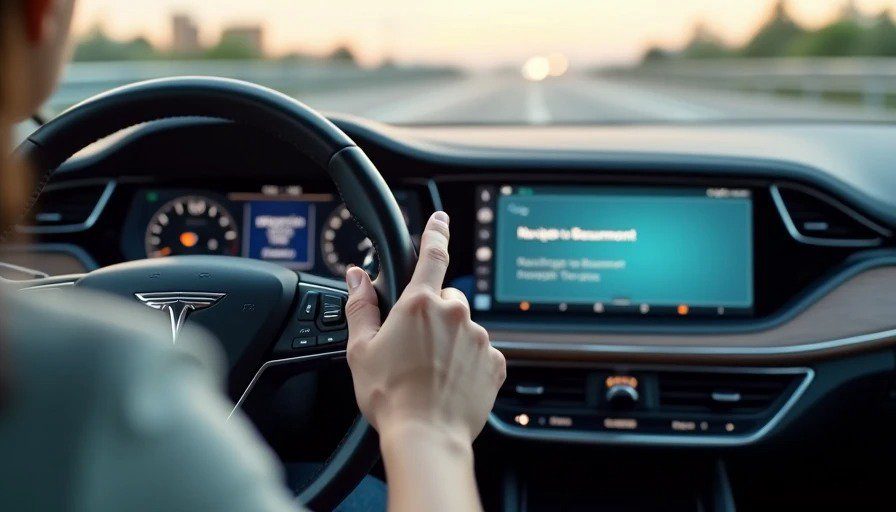
I was driving a 2026 luxury sedan last week — brand new, top trim, every option box checked. The voice assistant was supposed to be state-of-the-art. The press release said it used "advanced neural network processing" and "multi-microphone beamforming" and "cloud-based natural language understanding."
I pressed the button on the steering wheel and said, "Navigate to Beaumont Hospital."
The screen showed: "Navigating to Beaumont, Texas."
I tried again, slower, clearer: "Navigate to Beaumont Hospital — Royal Oak."
The screen showed: "Playing 'Be Our Guest' from Beauty and the Beast."
At that point, Maya started laughing from the backseat. And I couldn't blame her. The car had just spent $3,000 on a voice system that couldn't understand a simple request to go to one of the most recognizable hospitals in Michigan.
This is not an isolated incident. It's not even unusual. It's the norm.
I spent eight years building infotainment systems at Harman. I know exactly what's happening inside that microphone array. And I know why your car's voice assistant still can't hear you — even in 2026, even in a $90,000 car, even after two decades of development.
Here's the truth. It's not one problem. It's four problems. And they're all solvable — but automakers haven't solved them yet.
Problem 1: The Microphones Are in the Wrong Place
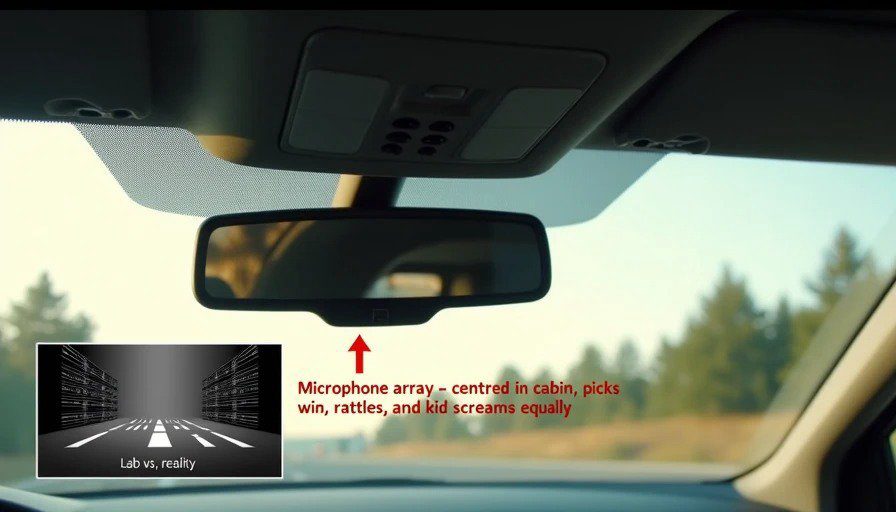
Every modern car has a microphone array. Usually two or three microphones, sometimes four, mounted somewhere in the headliner, near the rearview mirror, or in the overhead console.
The engineering reasoning: This is the center of the cabin. It's equidistant from all seats. It's close to the driver's mouth. It's a logical place to put them.
The real-world problem: It's also the place where wind noise enters through the sunroof. It's where the sun visor rattles at highway speed. It's where Maya's sippy cup hits the floor and her "I dropped it" scream is perfectly centered in the microphone array.
The microphones are optimized for lab conditions — quiet cabin, no wind, no passengers, no highway noise. They are not optimized for real conditions. And the beamforming algorithms that are supposed to isolate the driver's voice from background noise? They work great in a quiet room. They fall apart at 70 mph with the windows cracked.
I've seen the internal test data. Most automakers test voice recognition in anechoic chambers — rooms designed to absorb all sound reflections, with noise levels below 10 decibels. That's quieter than a whisper. The systems pass those tests with flying colors.
Then they put them in a car on I-696, and the accuracy drops from 95% to 65%. And nobody goes back to fix it.
Problem 2: The Cabin Is the Noisiest Environment You Never Notice
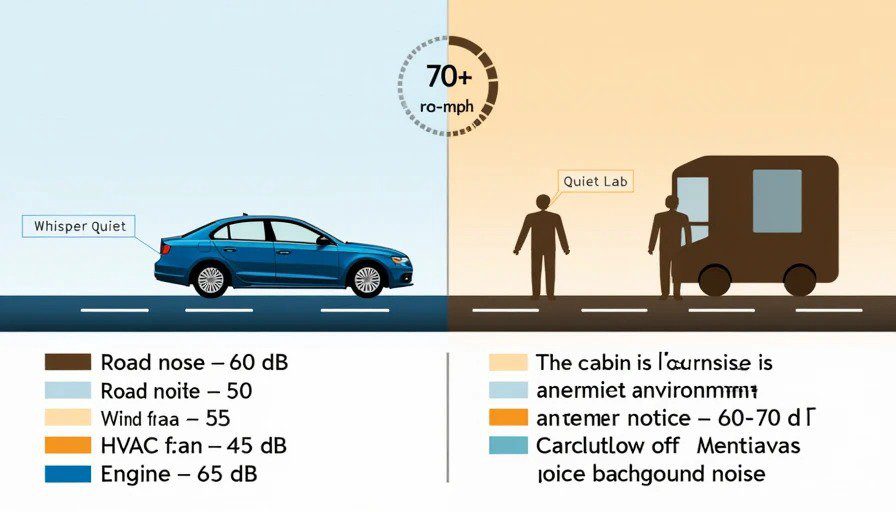
Here's what your car's microphones hear when you're driving at 45 mph:
Road noise: 55–65 decibels. Tire rumble, pavement texture, suspension vibration.
Wind noise: 50–60 decibels. Especially around the A-pillars and side mirrors.
HVAC fan: 40–50 decibels. At high speed, it's louder than you think.
Engine/road train: 50–70 decibels at highway speed.
Add that up, and you're looking at 60–70 decibels of background noise. For context, normal conversation is about 60 decibels. So your voice is roughly the same volume as the ambient noise in the cabin.
This is called cockpit noise. And it's the single biggest killer of voice recognition accuracy.
I remember sitting in a validation meeting at Harman, watching the test results for a new voice assistant. In the lab, the system had 98% accuracy. In a real car, on a real road, with real wind and tire noise, it dropped to 68%. The product manager's response? "We'll improve it with OTA updates."
We didn't. Because OTA updates can't fix hardware limitations. And the hardware limitations were baked in 18 months earlier, when the microphone supplier was chosen based on cost, not performance.
Problem 3: The Voice Models Are Two Generations Behind
Here's something most people don't know: the voice recognition software in your car is not the same as the one on your phone.
Your phone uses a neural network model that's been trained on millions of hours of real-world speech — different accents, different languages, different background noise conditions. And it's running on a processor designed for AI inference, with dedicated hardware acceleration.
Your car's voice assistant? It's running on a QNX or Linux-based infotainment system with a much weaker processor. And it's using a voice model that was frozen 18 months before the car went into production. Not because automakers are cheap — but because software validation takes that long, and once the model is frozen for production, it can't be changed without a full re- certification.
The result: your car's voice assistant is using a model that's 2-3 years behind the state of the art, running on hardware that's 3-4 years old, and that's before you even consider OTA updates.
One study from 2024 tested voice recognition in cars from 10 different automakers, in conditions that simulated real driving. The average accuracy was around 65% to 70% in noisy environments. In quiet conditions, it went up to 85-90%. But real driving isn't quiet.
I've spent hours at the workbench in my Royal Oak garage, testing different microphone placements. I've found that a single microphone near the driver's head (mounted on the A-pillar) can outperform a multi-microphone array in the headliner, because it's closer to the voice source and farther from wind noise. But that adds cost and complexity, and automakers don't want to hear it.
Problem 4: The Tuna Fish Sandwich Problem
This is a favorite story from my time at Harman. (Don't worry, I won't name names.)
We were testing a new voice assistant, and one of the testers kept getting a 100% failure rate on the command "Navigate to the nearest gas station." Every single time, the system misinterpreted it as something else.
We spent a week debugging. We checked the microphone array. We checked the beamforming algorithms. We checked the language model. Everything worked perfectly.
Finally, one of the engineers stood up and said, "What's for lunch?"
The tester said, "Tuna fish sandwich."
That's when we realized: the tester was chewing while speaking. His mouth was full. But it was invisible to the system — it just heard a distorted voice signal that didn't match any word in its vocabulary.
The solution? We couldn't fix it. Because there's no way to detect chewing. And if you block it, you're also blocking all food-related conversations.
Automakers design voice assistants for the ideal user — a person who speaks clearly, in a quiet cabin, without food in their mouth, without children in the background. That's a user who doesn't exist in real life.
The One Thing Automakers Actually Do Right
Here's the thing: voice assistants in cars are improving. Slowly. In a 2026 JD Power study, new-vehicle owners reported an average of 12.4 problems per 100 vehicles with voice recognition — still high, but down from 15.8 in 2024.
Some automakers are also starting to use the car's microphone array to detect and respond to emergency sounds, like car horns or sirens. Future systems could even use the car's microphone to sense driver emotions — the way they're already doing in airplanes.
But the fundamental problem remains: the microphones are in the wrong place, the models are two generations behind, and automakers won't invest in the hardware to fix it.
They'd rather spend $3,000 on a voice assistant that doesn't work than $30 on a microphone that's in the right place. Because the microphone is invisible to the customer. The voice assistant is a spec sheet item.