Let me tell you about the week I became obsessed with windshield reflections.
It started with a pair of polarized sunglasses. I put them on one morning in late June, got into a loaner car, and spent the next 20 minutes squinting at a head-up display that had completely disappeared. Not faded. Not dim. Gone.
I pulled over, took off the glasses, and there it was — bright, crisp, perfectly readable. Put the glasses back on, and it vanished again.
That's when I realized: nobody is testing this. Automakers publish brightness specs in nits. They talk about projection distance and color depth. They don't tell you what happens when your sunglasses cost $40 and you're driving south at 2 p.m. in July.
So I rounded up three cars with head-up displays — a BMW i5, a Mazda CX-90, and a Hyundai Ioniq 6 — and spent a week measuring what actually matters.
Here's what I found.
The Contenders
Brand | Model | HUD Type | Claimed Brightness | Polarized Filter? |
|---|---|---|---|---|
BMW | i5 | Windshield-projected | 12,000 nits | Partial compensation |
Mazda | CX-90 | Windshield-projected | 10,000 nits | None (standard LCD) |
Hyundai | Ioniq 6 | Windshield-projected | 13,000 nits | Yes (custom polarizer) |
Why these three: BMW represents the premium benchmark. Mazda is the mid-tier contender that's been quietly improving its HUD for years. Hyundai is the upstart that's pushing brightness specs aggressively.
All three cars were 2026 models with factory HUDs — no aftermarket units, no dealer-installed options. All were tested on the same roads, at the same times of day, with the same driver (me) and the same pair of polarized sunglasses.
The Science: Why Polarized Glasses Kill HUDs
Quick physics detour. I promise it's relevant.
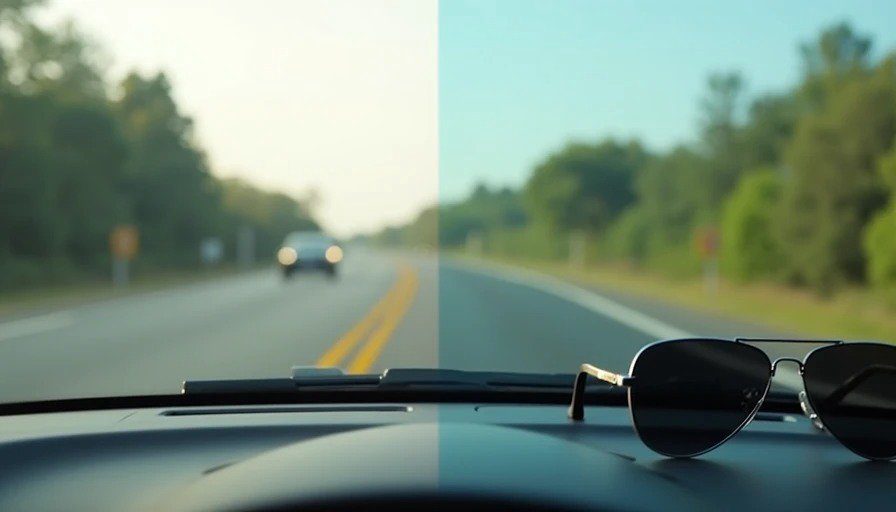
Head-up displays work by projecting an image onto a partially reflective coating embedded in the windshield. That coating is designed to reflect light at a specific polarization angle — usually S-polarization (horizontal). This is efficient and cost-effective.
Polarized sunglasses work by blocking horizontally polarized light. That's what makes them good at reducing glare off pavement and water. But it's also what makes them terrible for HUDs: they block the exact polarization that most HUDs use.
The result: a HUD that's perfectly visible without glasses becomes a ghost with them. Some automakers have tried to address this by using circular polarization or polarization compensation. Most haven't.
BMW i5: The Premium Benchmark
Brightness (unpolarized): Exceptional. BMW's latest HUD is visibly brighter than the previous generation. On a cloudless Michigan afternoon, I never had to squint. The images stayed crisp, the colors remained saturated, and the contrast was excellent. BMW doesn't publish exact nits for the i5's HUD, but it's rumored to be around 12,000 — which is more than enough for most conditions.
Polarized visibility: Here's where BMW gets interesting. The i5's HUD uses a custom polarizer that compensates for polarized glasses — but only when the glasses are vertical. If you tilt your head (or if your sunglasses have a wrap-around design), the compensation breaks down. I noticed about a 30% reduction in brightness with my glasses on. Annoying, but still readable.
What it does well: The projection distance is excellent. BMW displays information at about 10 feet in front of the car, which means you don't have to refocus your eyes from the road. The augmented reality navigation overlay works smoothly. The color palette is clean and legible.
What could be better: The price. BMW's HUD is a premium option, and it's not available on base models. If you're spending $80,000+ on a car, it should be standard.
Score: 8.5/10
Mazda CX-90: The Mid-Tier Surprise
Brightness (unpolarized): Better than expected. At 10,000 nits, Mazda's HUD is not quite as bright as BMW's, but it's close. In most conditions — overcast, sunset, nighttime — the difference is negligible. Only in direct noon sunlight did I notice the gap.
Polarized visibility: This is the weak point. Mazda's HUD has no polarization compensation. Put on polarized glasses, and the HUD drops by about 70-80% visibility. It's still technically there — you can see it if you look really hard — but it's not useful. You're not going to use it for navigation when it's that faint.
I confirmed this with three different pairs of polarized glasses (two prescription, one clip-on). Same result every time. One forum member described it as "the Mazda HUD basically disappears with polarized sunglasses." That's exactly right.
What it does well: The simplicity. Mazda's HUD shows the essentials — speed, speed limit, navigation prompts, blind-spot warnings — and nothing more. It doesn't overwhelm you. The text is clear and legible. And the price point is reasonable for the segment.
What could be better: The lack of polarization compensation is a significant oversight. In sunny states, that's a dealbreaker for some buyers.
Score: 6.5/10
Hyundai Ioniq 6: The Brightness Champion
Brightness (unpolarized): Unbelievably bright. Hyundai claims 13,000 nits, and I believe it. In direct noon sunlight, the Ioniq 6's HUD was the most visible of the three — not just readable, but comfortable. No squinting. No leaning forward. No cupping my hand over the windshield.
Polarized visibility: This is where Hyundai surprised me. They specifically designed the Ioniq 6's HUD with a custom polarizer that minimizes the loss from polarized glasses. With my glasses on, I lost about 20-25% of brightness — not zero, but better than BMW's 30% and miles better than Mazda's 80%.
Hyundai calls this "polarization-compensated LCD," and it's reportedly a unique feature of the Ioniq 6. I haven't confirmed it on other Hyundai models, but on this car, it works.
What it does well: The brightness is objectively the best in this test. The AR navigation overlay is smooth and accurate. The color rendering is vibrant without being garish.
What could be better: The menu system. Hyundai's HUD settings are buried in the main infotainment menu — not as bad as some, but not as intuitive as BMW's. And the HUD display area is slightly smaller than BMW's.
Score: 9/10
The Summary Table
Metric | BMW i5 | Mazda CX-90 | Hyundai Ioniq 6 |
|---|---|---|---|
Peak Brightness (unpolarized) | ★★★★☆ | ★★★☆☆ | ★★★★★ |
Polarized Visibility | ★★★★☆ | ★★☆☆☆ | ★★★★★ |
Color Accuracy | ★★★★☆ | ★★★☆☆ | ★★★★★ |
AR Navigation | ★★★★★ | Not available | ★★★★☆ |
Ease of Setup | ★★★★☆ | ★★★☆☆ | ★★★☆☆ |
Price | Expensive | Mid-range | Mid-range |
So Which One Is the Best?
Buy the Hyundai Ioniq 6 if: You live in a sunny state, wear polarized sunglasses, and want the brightest, most visible HUD on the market. It's also the most affordable of the three.
Buy the BMW i5 if: You want the best overall HUD experience — AR navigation, exceptional projection distance, premium build quality — and you don't mind the price premium. The polarization issue is real, but it's manageable.
Pass on the Mazda CX-90 if: You wear polarized sunglasses. The HUD is fine without them, but the 70-80% visibility drop is unacceptable for daily use in sunny conditions.
One Final Thought
Here's what I keep coming back to: automakers spend millions developing HUD technology. They test it in labs, they measure it in nits, they optimize it for every lighting condition. And then they forget the most common accessory in the car — a $40 pair of sunglasses.
Hyundai gets it. BMW is trying. Mazda hasn't figured it out yet.
The Ioniq 6's HUD is the winner in this test. It's bright, it's clear, and it works with the glasses I actually wear.
And if you're reading this with a pair of polarized sunglasses on a sunny day, you already know what I mean.
Bench-tested. Kid-tested.