I spent an afternoon last week driving two cars back-to-back. A 2026 Audi Q6 e-tron and a 2026 Toyota Camry XSE Hybrid. Both have fully digital instrument clusters. Both are current-generation products from major automakers. Both cost roughly the same, adjusted for class.
They could not be more different.
The Audi's cluster looks like a video game. The graphics are smooth. The animations are fluid. The navigation map slides across the screen like it's on rails. The speedometer needle sweeps with the kind of grace that makes you want to accelerate just to watch it move. It's beautiful. It's engaging. It's a feast for the eyes.
The Toyota's cluster looks like a spreadsheet. The speed is displayed in a clean, white font. The tachometer is a simple bar. There are no animations, no gradients, no visual flair. It tells you everything you need to know and nothing more. It's efficient. It's functional. It's boring.
Both displays have the same resolution, roughly the same size, and similar pixel densities. The difference isn't hardware. It's philosophy.
I spent eight years building infotainment systems at Harman. I've seen the engineering behind both approaches — and I've seen the crashes, the lag, and the compromises that come with each. Here's why some digital clusters look like video games and some look like spreadsheets, and why the difference matters more than you'd think.
The Game-Makers: Audi, Mercedes, Porsche, and the VW Group
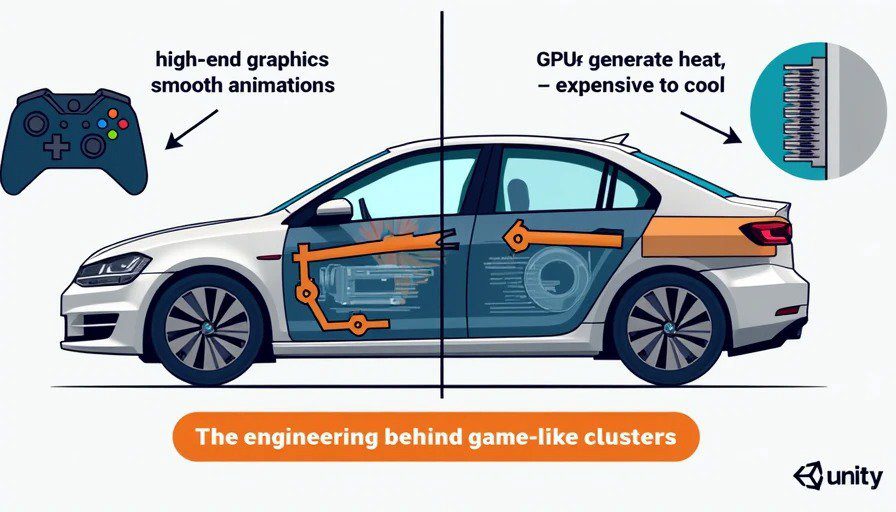
Audi's virtual cockpit, introduced in 2014, set the standard for "game-like" instrument clusters. It uses a custom version of Unity, the game engine. That's right — the same engine that powers first-person shooters and platformers is rendering your speedometer.
The advantage of using a game engine is obvious: you get high-end graphics. You get smooth animations. You get the ability to render complex 3D maps with real-time traffic data. You can have multiple views, customizable layouts, and transitions that feel premium.
The engineering trade-offs:
Processing power. A game engine requires a high-performance GPU. The Audi uses an Nvidia Tegra processor with dedicated graphics. That's more expensive than a standard automotive-grade CPU. Those costs get passed to the consumer. If you're wondering why a fully digital Audi cluster costs $3,000 as an option, now you know.
Heat management. GPUs generate heat. In a phone or a laptop, that's manageable. In a car, it's trickier. The cluster is mounted in a position that doesn't get much airflow. If the GPU overheats, the cluster lags or shuts down. Automakers have to design heat sinks and cooling channels, adding cost and complexity.
Boot time. A game engine takes time to load. The Audi cluster is slow to wake up — about 8-10 seconds from a cold start. That's because it has to boot the entire Unity stack before rendering anything. In our Standard Test, boot time is one of the five pillars, and game-based clusters consistently score lower.
Software bugs. A game engine is complex. It has millions of lines of code, many of which weren't written for automotive use. Those lines of code can have bugs that cause crashes, freezes, and glitches. I've seen Audi clusters freeze mid-drive, showing a solid black screen for three full seconds before restarting. That's not just annoying — it's a safety issue.
The Spreadsheet-Makers: Toyota, Honda, Hyundai, and Most of the Industry
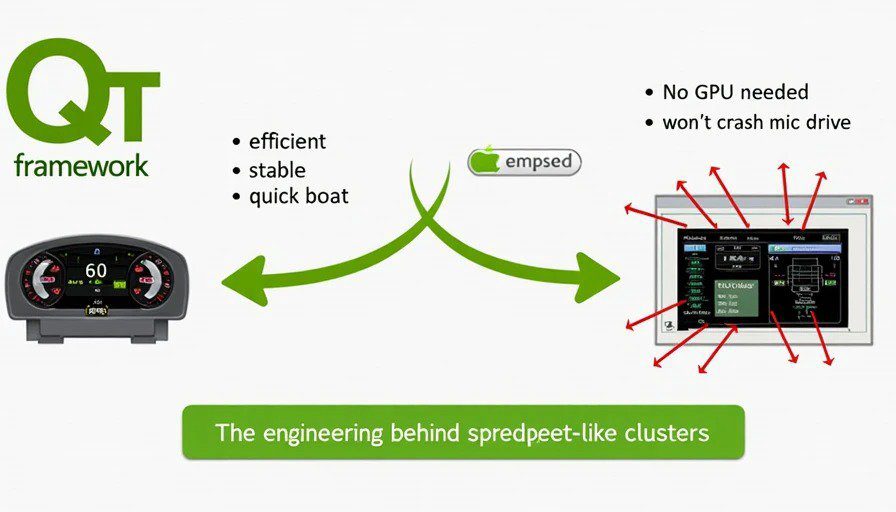
Toyota's approach is the opposite. Their digital cluster uses a standard automotive HMI framework — typically built on Qt, a lightweight graphics framework designed for embedded systems.
The advantage of using an embedded framework is efficiency. It doesn't need much processing power. It boots quickly. It's stable. It won't crash mid-drive, because it's doing very little — just rendering text, lines, and simple shapes.
The engineering trade-offs:
Limited graphics. You're not getting 3D maps or fluid animations with Qt. You're getting 2D vector graphics and basic transitions. It's functional, but it's not beautiful.
Less customization. Toyota lets you change the layout between a few preset options — but you can't design your own. The choices are limited. This is by design: more options means more complexity, which means more chance of bugs.
The "spreadsheet" aesthetic. The Toyota cluster is clean, legible, and boring. It doesn't try to impress you. It just tells you what you need to know. For many drivers, that's exactly what they want. For enthusiasts, it feels like a missed opportunity.
Why Hyundai's Approach Is the Sweet Spot
Hyundai sits between the two extremes. Their digital clusters use a hybrid approach: an automotive-grade framework with some GPU acceleration for animations. The 2026 Ioniq 6's cluster is smooth — not as smooth as Audi, but smoother than Toyota — without the heat, boot time, or bug issues of a full game engine.
I asked a Hyundai engineer at a show why they didn't go with Unity. He shrugged and said: "We could. But we'd have to charge you more, and you'd have to wait 10 seconds to see your speed. Our customers don't want that."
That's the kind of pragmatism I respect.
The Dad Mode Test: Which One Works Better With a Toddler?
Here's the truth: Maya doesn't care what the cluster looks like.
She cares whether I'm looking at the cluster or at her. When the cluster is smooth and game-like, I find myself glancing at it more often — not to check my speed, but to watch the animations. It's engaging. That's the point. But it's also distracting.
When the cluster is spreadsheet-like, I glance at it for half a second, get the information I need, and look back at the road. It's boring. That's also the point.
The bottom line: If you're a driving enthusiast who wants to feel connected to the car, a game-like cluster might enhance the experience. If you're a parent who wants to minimize distractions, a spreadsheet-like cluster is probably safer.
The One Thing All Digital Clusters Are Missing
Both approaches share a common flaw: they don't handle glare well.
In direct sunlight, the game-like clusters are harder to read because the anti-glare coating on the high-gloss displays is often minimal — automakers want the colors to pop, and coatings reduce contrast. The spreadsheet-like clusters are better, but they're still not as readable as a physical gauge cluster.
One reviewer noted that "hybrid analog-digital clusters are preferred for their clarity and legibility." That's the industry's quiet admission that the technology isn't quite there yet.
What's Coming Next
The next generation of digital clusters will be even more game-like. BMW's Neue Klasse, due in 2027, will feature a panoramic head-up display that covers the entire windshield. It's essentially a game engine projecting directly onto glass. Audi is developing AR navigation that overlays turn-by-turn directions onto the road ahead. These will be beautiful and engaging.
But they'll also be more distracting. And more complex. And more expensive to fix when they break.
The Bottom Line
Buy the game-like cluster if:
You're an enthusiast who enjoys the visual experience of driving
You want customization and multiple layout options
You're willing to accept longer boot times and the occasional glitch
Buy the spreadsheet-like cluster if:
You just want to see your speed and fuel level without distraction
You value reliability over visual flair
You don't want to pay a premium for graphics you'll mostly ignore
Buy the hybrid (like Hyundai) if:
You want the best of both worlds
You want smooth animations without the lag, heat, and bugs
I keep going back to the difference between the Audi and the Toyota. Both are good cars. Both have competent digital clusters. But they reflect two different philosophies about what a car should be.
Audi thinks the cluster should be part of the experience. Toyota thinks the cluster should get out of the way. Neither is wrong. But when you're merging onto I-696 with a four-year-old in the backseat, the one that gets out of the way is probably the safer choice.
That's not a knock on Audi. It's just a reminder that the best interface is the one that works when you need it.
And when you need it, you don't need a video game. You need your speed, your fuel, and your eyes on the road.
Bench-tested. Kid-tested.