When people search for car speakers and better sound, they often start with wattage. That is understandable, but wattage is one of the least useful numbers on a box. The real experience comes from speaker sensitivity, cabin placement, factory tuning, road noise, and whether your head unit can deliver a clean signal. I have heard a modest 6.5-inch system outperform a much more expensive setup because the integration was done correctly. Bench-tested. Kid-tested.
Start with the factory system, not the shopping cart
Before buying anything, identify what your vehicle already has. Count the speaker locations, note the sizes, and find out whether the factory system uses an external amplifier. A 6.5-inch door speaker is common, but some vehicles use shallow speakers, unusual mounting brackets, or proprietary connectors. A replacement that technically fits may still interfere with a window mechanism or leave a gap around the mounting surface.
Listen for the specific problem. If music sounds thin, larger full-range speakers or a small subwoofer could help. If vocals sound harsh, the issue might be factory equalization rather than the speaker itself. If the system gets muddy when you turn it up, adding a powerful amplifier without correcting the signal will simply make the mud louder. This is where many car speakers and audio upgrades go wrong: the buyer improves one component while leaving the original limitation untouched.
Factory systems also use digital processing to make small speakers sound more impressive. Replacing them with aftermarket units can remove that carefully shaped balance. The result might be louder but less natural. A good installer measures the output and checks polarity instead of relying on a product description.
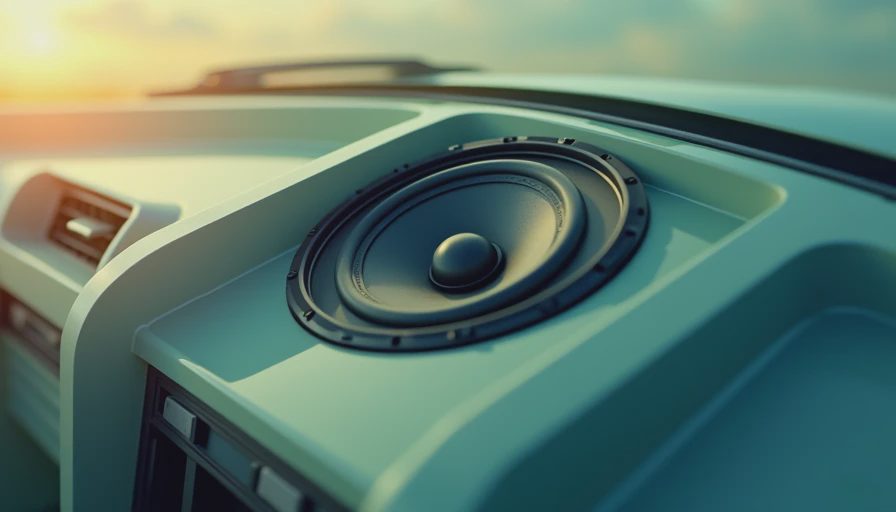
Choosing car speakers and the right type of driver
Most factory systems use coaxial speakers, with the tweeter mounted in the center of the woofer. They are practical, affordable, and usually the simplest replacement. Brands such as JBL, Alpine, Kicker, Pioneer, and Rockford Fosgate offer several coaxial lines in common sizes. Prices typically range from about $60 to $180 for a pair, before installation.
Component systems separate the woofer and tweeter. The tweeter can be mounted higher in the door or dashboard, which often improves the stereo image and makes voices easier to place. A basic component set commonly costs $150 to $400. Installation is more involved because the tweeter needs a secure mount and the crossover must be connected correctly.
For car speakers and a family-friendly daily system, I usually prefer a balanced component set in the front and a reasonable coaxial pair in the rear. Rear passengers get useful fill, while the front stage remains the focus. Putting expensive components in every location can be wasteful if the factory amplifier cannot provide enough clean power.
Sensitivity matters more than many shoppers realize. A speaker with a rating around 90 dB can play loudly with modest factory power, while a low-sensitivity model may need an amplifier to reach its potential. Impedance matters too. Replacing a factory 2-ohm speaker with a 4-ohm unit can reduce output, especially in systems designed around a compact factory amplifier.
The hidden problem: integration
The most important part of car speakers and an upgrade is often the interface between old and new hardware. Modern vehicles may route warning chimes, navigation prompts, phone calls, and parking alerts through the same audio architecture as music. A careless installation can produce buzzing, missing alerts, weak bass, or a system that shuts down when the volume rises.
A line output converter can translate amplified factory output into a signal an aftermarket amplifier understands. Some vehicles need a vehicle-specific interface to retain steering-wheel controls, fader functions, and factory displays. That extra hardware is not glamorous, but it is what keeps the cockpit behaving like a cockpit rather than a collection of disconnected gadgets.
This also explains why a direct speaker swap sometimes feels disappointing. The factory head unit may apply equalization designed for the original speakers. The replacement then receives a signal that already has bass and treble corrections baked in. A digital signal processor can correct that behavior, but it adds cost and tuning time. For many drivers, a properly installed speaker set and sound-deadening treatment offer a better value than immediately adding a DSP.
Sound-deadening without turning the door into a science project
Door panels are thin, irregular spaces. They vibrate, leak air, and allow outside noise into the same area where the speaker is trying to create sound. Applying butyl damping material to large resonant sections of the inner door can reduce panel vibration. Sealing the speaker against the mounting surface with a foam gasket helps prevent front and rear sound waves from mixing.
Do not cover every square inch automatically. Extra material adds weight and can complicate service access. The useful goal is a rigid speaker mount and a reasonably sealed enclosure around the woofer. Foam rings, adapter brackets, and moisture-resistant mounting surfaces are inexpensive details that often matter more than a shiny grille.
For car speakers and highway listening, this work can make bass seem stronger without adding amplifier power. It also reduces the temptation to turn up the volume to overcome tire and wind noise. On a family drive, that matters: the person in the second row should hear the podcast without the front passenger feeling like the system is shouting.

Matching an amplifier and subwoofer
An amplifier is useful when the factory system runs out of clean output, but more power is not automatically better. Choose an amplifier based on the speaker's continuous power handling and the vehicle's available space. Compact five-channel amplifiers can run front and rear speakers plus a small subwoofer, while a dedicated four-channel unit keeps the system simpler.
A powered subwoofer is often the best upgrade for listeners who want fuller music without sacrificing cargo room. Under-seat models from JBL, Alpine, and Kicker can add low-frequency weight in a compact package. They will not reproduce every bass note like a large enclosure, but they can make drums, electronic music, and movie soundtracks feel complete. Set the gain conservatively; gain is not a volume knob, and excessive adjustment creates distortion.
A clean system should remain comfortable at normal listening levels. If the treble becomes painful or voices turn brittle, reduce the level and revisit the tuning. The best car speakers and amplifier pairing is the one you can use for an hour without fatigue, not the one that wins a ten-second parking-lot demo.
A practical buying plan
Start by spending 10 minutes listening to familiar recordings in the parked vehicle. Write down whether the issue is missing bass, harsh treble, weak volume, or poor clarity. Then verify the factory speaker size, impedance, depth, and amplifier arrangement. Ask an installer whether the vehicle needs brackets, wiring adapters, a signal interface, or retention hardware for factory alerts.
For a modest budget of $250 to $500, prioritize front speakers, mounting adapters, and installation quality. Around $600 to $1,200, you can add damping, a compact amplifier, or a powered subwoofer. A larger budget should go toward measurement and tuning rather than simply selecting the most expensive product on the shelf.
Car speakers and modern infotainment systems work best when treated as one system. The phone connection, head unit, amplifier, speakers, and cabin materials all shape what reaches your ears. Spend first on the weakest link, preserve the features you use every day, and test the finished installation with music, podcasts, calls, and navigation prompts. That is how you get a cockpit that sounds better without making everyday software and hardware less usable.